
Short answer: A bamboo handle is a plant-based alternative to a plastic one. Charcoal-infused bristles are nylon bristles with charcoal added, which gives them their dark colour. Both describe what a brush is made of, not what it does to your pet's teeth. What removes plaque is technique: soft bristles angled at about 45° to the gumline, a head that fits the mouth, brushing every day, and a new brush every three months or sooner if the bristles splay.
Which part actually matters?
If you have ever stood in front of a shelf of pet toothbrushes wondering whether bamboo or charcoal makes a difference, here is the honest answer: the brush matters less than the hand holding it. Plaque is soft. It comes away when bristles sweep along the gumline, and it hardens when they do not.
A dog's or cat's saliva is alkaline, at around pH 7.5 to 8.5, and soft plaque can begin to mineralise into tartar within about 48 to 72 hours. So the features that count are the ones that help you brush gently, accurately and every day. Materials come second.
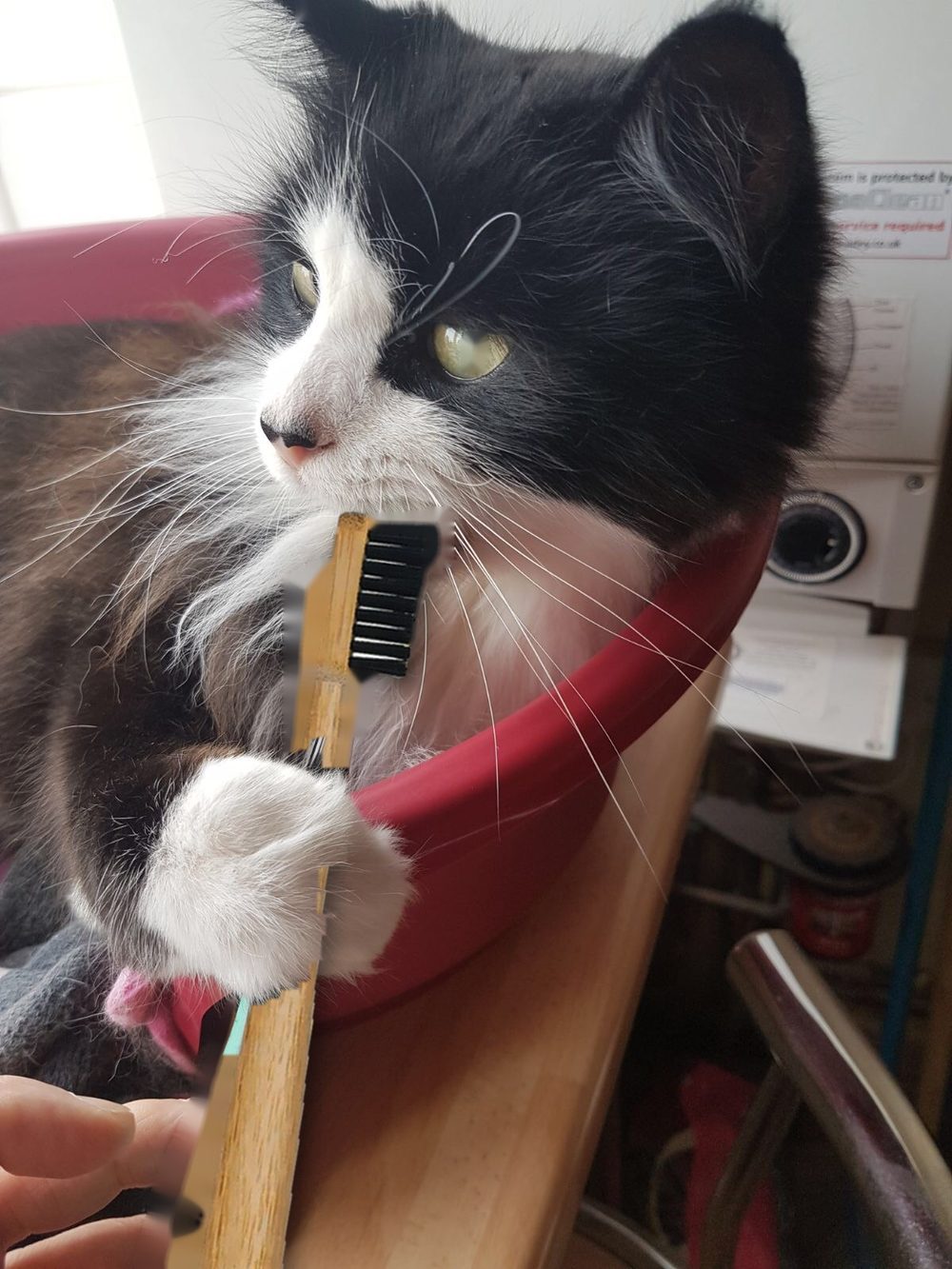
The handle: what bamboo is, and what it is not
Bamboo is a plant, grown and harvested, and a bamboo handle uses it in place of moulded plastic. Our Eco Bamboo Charcoal Toothbrushes have bamboo handles, and our brush case is bamboo too. That is a genuine material choice, and one we are glad to make.
It is not the whole story. The bristles are nylon, so the brush is not plastic-free, and we do not describe it as if it were. UK advertising rules expect environmental claims to reflect a product's whole life cycle and to avoid vague phrases such as "better for the planet". So we say what the handle is made of, and stop there. The "Eco" in the name refers to the bamboo handle and case, nothing more.
The bristles: what "charcoal-infused" means
Charcoal-infused bristles are nylon filaments with charcoal mixed into them, which is why they are dark grey or black. On our brushes they are also ultra-soft and micro-tapered: each filament narrows to a fine tip. Ultra-soft, fine-tipped bristles are gentle on delicate gums.
That is a description of a material, not a claim. We do not say that charcoal in a bristle does anything to bacteria, to breath or to the colour of teeth, and you should be wary of any brush sold as if it does. How soft the bristles are, and how you use them, is what counts.
What actually removes plaque: technique
Plaque is removed mechanically: something has to move across it. The technique is the same whatever the brush is made of.
- Angle. Tilt the bristles at about 45° towards the gum, so they sweep the line where tooth meets gum.
- Pressure. Light. If the bristles splay flat, you are pressing too hard. A dog's or cat's enamel is only about 0.1 to 0.6 mm thick, against roughly 2 to 2.5 mm on a human tooth.
- Movement. Small back-and-forth strokes or small circles along the outer surfaces, one side at a time.
- Time. About 30 to 60 seconds a side for a dog, and around 30 seconds a side for a cat once accepted.
- Frequency. Every day, or every other day at the very least, to stay inside the 48 to 72 hour window.
A pet toothpaste that is safe to swallow makes brushing welcome. It never replaces the movement of the bristles.
Choosing a brush by mouth size
The right head reaches the back teeth without forcing the mouth open.
- Cats and toy breeds. The smallest head and the softest bristles, or a finger brush.
- Small and medium dogs. A small head on a handle long enough to reach the cheek teeth comfortably.
- Large dogs. A larger head and a longer handle. A dual-headed brush, with a large head at one end and a small one at the other, covers big cheek teeth and small front teeth.
- Beginners of any size. A finger brush first, then a handled brush once your pet accepts it.
Short-muzzled breeds fit the same 42 teeth as any other dog into a much shorter jaw, so a small head matters even for a sturdy dog. Above all, the right brush is the one your pet accepts every day.
Caring for a bamboo brush
After each use, rinse the brush under running water, tap it dry and stand it upright where air can reach it. The bamboo case is for travel: pack the brush dry, and take it out to air when you arrive. Give each pet their own brush, keep it apart from the family's toothbrushes, and store it out of reach, because a brush left within reach soon becomes a chew toy.
When to replace it
Replace a pet toothbrush every three months, or sooner if the bristles splay, flatten or lose their shape, if the handle cracks or splinters, or if your pet has chewed it. Splayed bristles no longer sit at the gumline, however carefully you hold them. At the end of its life, pull or snip out the bristle tufts and put them in general waste, then dispose of the handle as your local council advises.
What we sell, and what we claim
Our Eco Bamboo Charcoal Toothbrushes pair a bamboo handle with ultra-soft, micro-tapered, charcoal-infused bristles; the country of manufacture is printed on the pack, as it should be on any brush you buy. We also sell a bamboo case for travel, and finger toothbrushes for the early weeks and for pets who prefer them. We claim what the materials are, and that soft bristles are gentle on delicate gums. The rest comes from your technique and your daily habit. See our toothbrushes.
When to see your vet
If you notice loose or wobbly teeth, swelling, discharge, bleeding that does not settle, reluctance to eat, dropping food, drooling, pawing at the mouth or any change in behaviour, please contact your veterinary surgeon promptly. Home care supports professional care — it never replaces it.