
Short answer: Go slower than you think. Over 21 days, move from stroking the cheeks, to lifting the lip, to a lick of cat toothpaste, to a fingertip or gauze along the gumline, to a finger brush or tiny soft brush, advancing only when your cat is relaxed and ending every session before they object. Use a toothpaste made for cats that is safe to swallow, angle the bristles at 45° to the gumline and clean the outer surfaces, about 30 seconds a side. Stop and see your vet if you notice a red gum line, drooling, pawing at the mouth or reluctance to eat.
Why cats need a slower plan
Cats hide discomfort brilliantly, like to be in control and remember a bad experience. One rushed session can undo a week of progress, so this plan moves in smaller steps than our dog method and spends longer on each.
Before day one, take a look. If you see a red line along the gums, bleeding or a broken tooth, or notice drooling, pawing at the mouth or a change in eating, see your vet first. Brushing a sore mouth teaches a cat that brushing hurts, and the soreness may need attention.
Many cats reach a full clean in 21 days; many need four weeks. Both are a success. And if your cat never accepts a brush, daily cleaning with gauze or a textured wipe along the gumline is a real result, not a consolation prize.
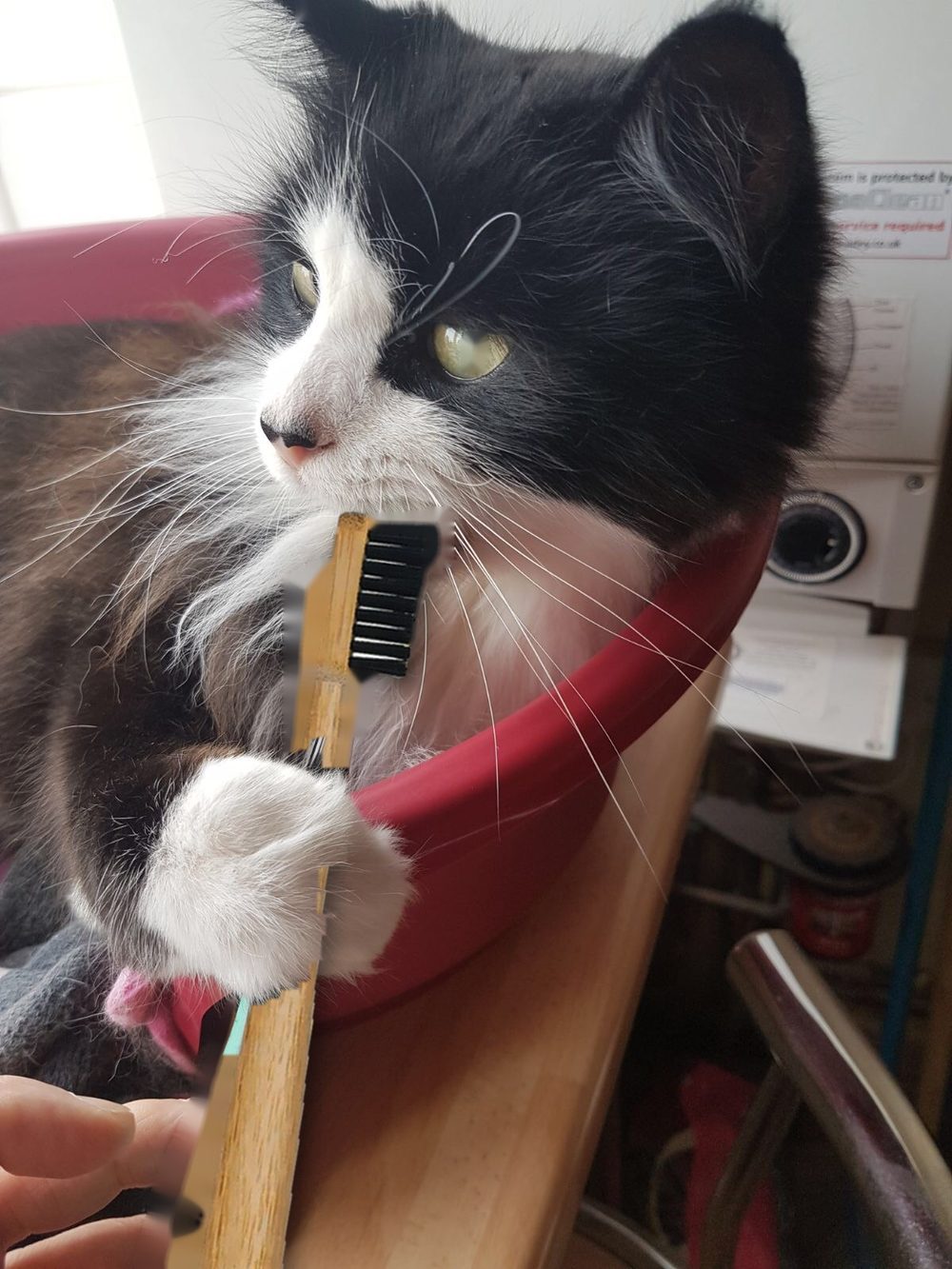
Handling and positioning
- Pick a calm moment. When your cat is relaxed and a little sleepy, in a quiet room, at the same time each day.
- Work from behind. With your cat on your lap or a table facing away from you, cradle the head gently with one hand from behind. Facing a cat head-on can feel confrontational to them.
- Towel-wrap: optional. A loosely wrapped towel keeps paws out of the way, and some cats find it reassuring. It is never a way to hold down a frightened cat.
- Seconds, not minutes. Early sessions last five to ten seconds. Even the finished routine takes only about a minute.
- End before they object. Finish while your cat is still relaxed, then offer something they love: a favourite morsel of food, a game or a gentle groom.
The 21-day ladder
Move up only when your cat is relaxed at the current rung. If they stiffen, flatten their ears, flick their tail or pull away, go back one rung for a day or two.
| Days | What you do | Move on when |
|---|---|---|
| 1–3 | Stroke the cheeks and muzzle during normal fuss, briefly touching the lips. Reward. | Your cat leans in rather than away. |
| 4–6 | Lift the upper lip for two or three seconds on each side. Offer a lick of cat toothpaste from your fingertip. | The toothpaste is taken as a reward. |
| 7–9 | Run a toothpaste-covered fingertip along the outer surfaces of the canines and front teeth for a few seconds. | No head-shaking or pulling away. |
| 10–12 | Finger brush, or gauze or a textured wipe around your finger, along the gumline of the canines and front teeth, five to ten seconds. | Calm on both sides. |
| 13–15 | Work back to the cheek teeth on one side, ten to fifteen seconds. Do the other side at the next session. | Both sides accepted, on separate days. |
| 16–18 | Both sides in one session, fifteen to twenty seconds each. Introduce a tiny soft brush now if you plan to use one. | The brush is accepted like your finger. |
| 19–21 | The full clean: about 30 seconds each side, outer surfaces, bristles at 45° to the gumline, then a reward. | It is part of the day. |
| Week 4, if needed | Repeat any rung that felt rushed, and settle the routine at the same time each day. | Your cat is relaxed from start to finish. |
Tools
- Finger brush. A good first tool for most cats: you can feel what you are doing and adjust the pressure.
- Tiny soft brush. A small head with ultra-soft bristles reaches the back teeth more easily once your cat accepts it.
- Gauze or a textured wipe. Wrapped around a finger, it cleans along the gumline, and many cats accept it more readily than bristles.
The right tool is the one your cat accepts every day. Replace brushes every three months, or sooner if the bristles splay.
Cat-safe toothpaste
Cats cannot rinse and spit, so everything you use is swallowed. Choose a toothpaste made and labelled for cats that is safe to swallow, and check the label for these:
- No essential oils or phenols. Tea tree, peppermint, eucalyptus and clove oils, and phenols, are a particular concern for cats, whose livers have very limited ability to process them.
- No xylitol.
- Never human toothpaste. It is made to be spat out and may contain fluoride and foaming agents.
- Dog toothpaste only if it is also labelled for cats.
A small smear is enough. Many cats prefer a meaty or poultry flavour, and on the early rungs the toothpaste is the reward. If your cat dislikes one flavour, try another before giving up on toothpaste altogether.
Technique
- With your cat settled and facing away from you, cradle the head gently from behind.
- Lift the upper lip at the side with your thumb. The mouth can stay closed.
- Angle the bristles, or your fingertip, at about 45° towards the gumline.
- Use small, gentle movements along the outer surfaces: canines first, then back along the cheek teeth.
- Spend about 30 seconds a side once your cat accepts it, and far less in the early days.
- No rinsing needed. Reward, and take a quick look at the gums as you finish.
Gentle means gentle. A cat's enamel is thin, a fraction of a millimetre, and the gums are delicate. Light pressure along the gumline does the work.
When to stop and see a vet
Stop brushing and book a veterinary check if you notice:
- a red line along the gums, or bleeding
- drooling, or pawing at the mouth
- reluctance to eat, or dropping food
- a broken or loose tooth, or swelling of the face or jaw
- bad breath that is new or strong
- a cat who suddenly resents having the mouth touched.
Seek urgent veterinary care straight away if your cat has difficulty breathing, heavy bleeding from the mouth, an injury to the face or jaw, or swelling of the face, tongue or mouth that is developing quickly.
When to see your vet
If you notice loose or wobbly teeth, swelling, discharge, bleeding that does not settle, reluctance to eat, dropping food, drooling, pawing at the mouth or any change in behaviour, please contact your veterinary surgeon promptly. Home care supports professional care — it never replaces it.
What home care cannot do
Daily cleaning helps reduce plaque build-up and helps keep tartar from building up, especially after a professional clean. It cannot remove tartar that has already hardened, and it cannot reach or assess what happens below the gumline, where some of the most important changes in cats' teeth take place. Those need your vet, often with dental X-rays under anaesthesia.
This is also why anaesthesia-free cleaning is not a shortcut. The American Animal Hospital Association's 2019 dental guidelines describe it as "not appropriate" for cats and dogs, because the areas below the gumline cannot be cleaned or assessed in an awake animal.