
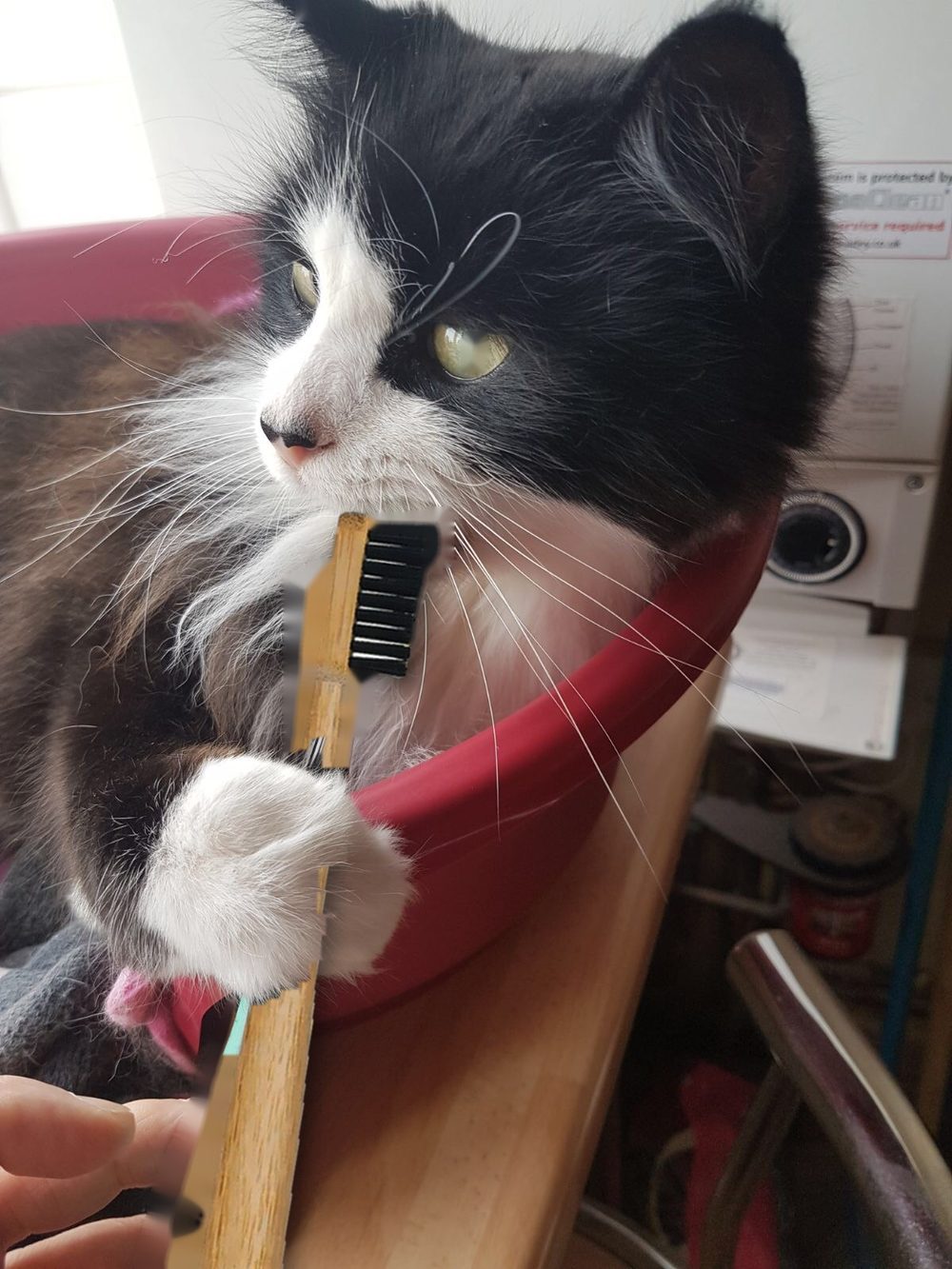
Short answer: A cat's mouth needs the same five steps as a dog's (Clean, Support, Maintain, Monitor and Professional care), but with cat-labelled products, a much slower introduction and closer watching, because cats hide discomfort. A 2023 Royal Veterinary College study found that 15.2% of UK cats are diagnosed with periodontal disease each year, and the odds rise steeply with age. Aim for gentle daily cleaning along the gumline, a weekly look at the mouth and a veterinary dental check at least once a year.
How a cat's mouth works
An adult cat has 30 teeth: small, sharp and set in a short jaw. Like dogs, cats have alkaline saliva (around pH 7.5 to 8.5), so they rarely get the cavities people do, but minerals settle readily into plaque, which can begin hardening into tartar within about 48 to 72 hours. Their enamel is thin, a fraction of a millimetre, so soft tools and light pressure matter.
The biggest difference is behavioural. Cats hide discomfort brilliantly, so changes in the mouth are easy to miss. That is why the weekly look in Step 4 matters even more for cats than for dogs, and why the annual veterinary check is not optional.
How common are dental problems in cats?
A 2023 Royal Veterinary College VetCompass study by O'Neill and colleagues sampled 18,249 cats from the records of more than 1.25 million UK cats under primary veterinary care. It found that 15.2% were diagnosed with periodontal disease in a single year.
Age was the strongest factor. Affected cats had a median age of 9.5 years, against 4.9 years for unaffected cats, and cats over nine had more than six times the odds of cats under three. Siamese (18.7%) and Maine Coon (16.7%) cats had the highest prevalence among the breeds studied.
The often-quoted American Veterinary Medical Association estimate that around 70% of cats show signs of oral disease by age three measures something different (any sign over a lifetime rather than diagnoses in one year), but the two point the same way.
Sources: O'Neill and colleagues, Royal Veterinary College VetCompass, periodontal disease in cats under primary veterinary care in the UK (2023); American Veterinary Medical Association (February 2026). Population figures are for education only. They are not a statement about your cat or about any product.
What vets look for in a cat's mouth
This section is education, not a home checklist. It explains why a veterinary examination matters so much for cats, and why some of the most important problems cannot be seen from the outside.
- Gingivitis. Redness and swelling at the gum edge, often seen as a red line where gum meets tooth.
- Periodontal disease. Damage to the tissues that hold a tooth in place, which develops below the gumline.
- Tooth resorption. A process in which the structure of a tooth is gradually lost, often at or below the gumline. Much of it can only be assessed on dental X-rays under anaesthesia.
- Stomatitis. Widespread, severe soreness and redness of the soft tissues lining the mouth, which needs veterinary care.
Only a veterinary surgeon can examine a cat's mouth properly and decide what it needs, and no home-care product is designed to address these conditions. What you can do is notice change early and book the appointment.
When to see your vet
If you notice loose or wobbly teeth, swelling, discharge, bleeding that does not settle, reluctance to eat, dropping food, drooling, pawing at the mouth or any change in behaviour, please contact your veterinary surgeon promptly. Home care supports professional care — it never replaces it.
A slow introduction
Cats accept handling on their own terms. Work in seconds, not minutes, at the same calm time each day, and stop before your cat objects: a struggle today makes tomorrow harder.
- Stroke the cheeks and muzzle as part of normal fuss.
- Lift the lip for a second or two, then reward.
- Offer a lick of cat toothpaste from your fingertip.
- Rub a fingertip, gauze or finger brush along the outer surfaces at the gumline.
- Only then, if your cat is happy, try a tiny soft brush.
Our gentle 21-day method turns these steps into a day-by-day plan. Many cats need a fourth week, and that is still a success. If a brush is never accepted, daily cleaning with gauze or a textured wipe is a real result.
Cat-specific safety: cats are not small dogs
Many products sold for "pets" were designed around dogs. Cats need their own rules.
- No essential oils or phenols. Avoid tea tree, peppermint, eucalyptus and clove oils, and phenols. Cats have very limited ability to process these compounds, because a key liver pathway, glucuronidation, works poorly in cats.
- No high-iodine kelp. Kelp is naturally rich in iodine, and thyroid conditions are common in older cats. If your cat has one, ask your vet before using any kelp-containing product.
- No xylitol, and never human toothpaste. Choose a toothpaste made for cats that is safe to swallow; cats cannot rinse and spit.
- No hard chews. Cats' teeth are small, and chews do little for the gumline.
- Labelled for cats. A product for cats and dogs is fine if it gives a cat serving. A dog-only product is not.
- Cat evidence for cats. Results from dog studies are never assumed to apply to cats. We grade cat evidence separately, and it is often thinner.
Kittens: from 26 teeth to 30
Kittens have 26 baby (deciduous) teeth, replaced by 30 adult teeth by around six months. It is the easiest time to start: a kitten whose lips are lifted and teeth touched for a few seconds a day grows into a cat that finds it normal.
Kittens may chew more while teething, and soft toys are enough. If a baby tooth is still in place once the adult tooth has come through beside it, show your vet. Our puppies and kittens guide covers the first year.